
RCVS Exam Preparation
If you want to transition from an overseas clinician to a UK-registered Veterinary Surgeon, you may need to sit and pass the RCVS Examination.
Our study resources and support exist to help you pass the exam and become MRCVS.

The challenges of the RCVS Examination
The RCVS Examination is known to be one of the most challenging ones, alongside the NAVLE, due to the high level of language, knowledge and practical skills that it requires.
As if you were already a UK vet

The RCVS Examination assesses your knowledge and skills in a similar way to what happens with other veterinary students who have studied in the UK.
Except you haven't been through that process yourself, which poses some challenges...
There is no study plan
The exam covers ALL areas of Veterinary Medicine, including non-clinical areas. It's basically an exam about your entire veterinary degree, but tailored to the UK reality.
There aren't many affordable study resources
There aren't many resources available to study for the RCVS Exam, and those that exist can become very expensive for you to join, even though they are of very good quality.
Study resources are too scattered or not tailored to UK practice
Much of the study material, such as VetPrep, is used to study for the NAVLE, so the knowledge will be adapted to the USA and diseases they see there.
The curriculum is extensive, good quality resources are expensive, others are not necessarily adapted to UK practice.
Study is hard, your financial investment is high and the pass rate is low. Most candidates fail because they rely on 'Academic Hoarding' or US-centric apps. They lack the specific UK clinical logic that the exam tests you on.
How to Pass the Exam - The Roadmap of Minimalist Mastery
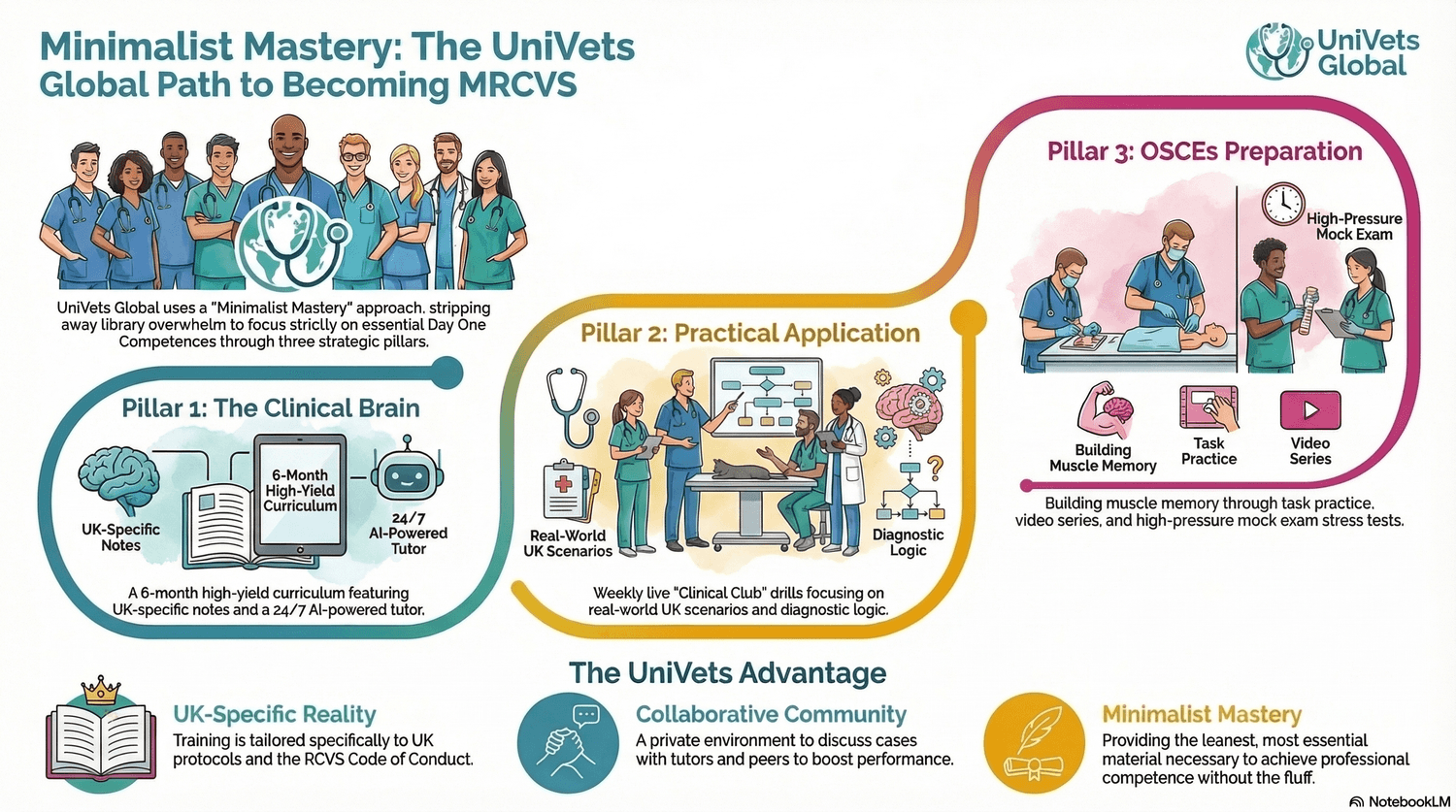
At UniVets Global, we believe in Minimalist Mastery: providing the leanest, most essential study material necessary to achieve Day One Competences, stripping away library overwhelm. This is achieved through our three core pillars:
Clinical Brain (written exam prep)
A 6-month long minimalist curriculum featuring high-yield, species-specific notes. This is supported by a 24/7 AI "Ask-Me-Anything" tutor trained specifically on UK protocols and a dedicated Code of Conduct interface to help you navigate the open-book exam.
Search 800+ pages of high-yield notes in seconds. No more digging through textbooks; get the UK-specific answer you need, when you need it.
Practical Application (live clinical club)
Weekly live sessions focused on scenario-based learning with real-world UK cases. Tutors run "What do you do next?" drills to build your clinical logic and confidence in high-fail areas like imaging and diagnostics
OSCEs Preparation
Moving from the screen to the surgery table to build muscle memory and manage exam stress. This includes low-pressure Task Practice to perfect your technical mechanics, high-pressure Stress Tests (Mock Exams) to simulate real exam conditions and identify "performance cracks," and a dedicated OSCE Video Series so you can "see it before you do it".
Community
Environment dictates performance. You will be able to join our private community to ask questions, share resources and discuss cases. You can also engage with your tutors (vets from the UK).

Where to Start
Actually not sure where to start?...
Need a study plan or general guidance?
Ready to master the written exams?
Need support for the OSCEs?
Questions about the exam and the UniVets Global resources
There are some courses available online, although not specifically for the RCVS. There is another course that advertises it’s specifically for the RCVS exam, but we have received VERY mixed reviews about the quality of that course and no longer recommend it.
To our knowledge, our course is the only one designed specifically for the RCVS exam, but is not endorsed by the RCVS and is not a guarantee that you can pass the exam, because this depends on how much you study and take in from the course. However, it does provide you with UK-specific content and resources for the study topics required by the examination.
Yes and no. We have a series of free resources in our free course which include study material, OSCEs preparation resources and is free to access - and will always remain free. The tutored version is paid on a monthly basis, so you can cancel it at any time. Our OSCEs preparation material is also paid.
It can be hard and overwhelming, so feel free to email us to explain your situation at info@univets.global. However, here's a quick overview:
If you are are considering taking the exam but have not signed up yet, take the exam readiness scorecard to get a masterplan.
Join the free course if you want to design a study plan and get some resources.
Join the Tutored Course if you want the most curated resources, clinical cases and direct tutoring. We cover all topics in 6 months. This is the most effective preparation tool.
If you can't see practice for the OSCEs, at least watch the video series, but if possible, join one of the practical training courses.
You need to take and pass the RCVS examination if you want to practise as a clinician in the UK and did NOT graduate from:
An EAEVE-accredited university
An AVMA-approved university
Other universities from Commonwealth countries (Canada, Australia, South Africa)
Let’s not sugarcoat it, yes it is. Since the new format in 2019 we are unaware of published pass rates. Before this change, the pass rate was anywhere between 10 to 45% depending on the year.
In 2025, the RCVS implemented a change that allows vets to re-sit the exam only in the parts that they failed and we expect this will improve the pass rates. Unofficially, the pass rates for the first part of the exam in 2025 were 20% (before the re-sits).
The exam has three parts: one theory part covering clinical practice and public health in the form of a multiple choice questionnaire; one part covering the Code of Conduct also in the form of multiple choice questionnaire; and the final part with practical tasks in all areas called the OSCEs.
For 2025, if you fail a section in the first part of the exam (the multiple choice questions), you can re-sit only that section. The same happens with the section on the Code of Conduct and the OSCEs (if you fail the section on equine OSCEs but pass the others, you can repeat only the equine OSCEs). It’s expected these rules would be the same for 2026.
The fee for sitting the exam in 2025 was £2500. However, if you need to take re-sits, they will have their own cost (about £500 per re-sit).