
How to Improve Your Veterinary Hands-On Skills - A complete guide for clinicians
How to Improve Your Veterinary Hands-On Skills
A complete guide on how to use your hands-on skills with confidence and professionalism
By Andreia Dias MRCVS DVM MSc ISFMAdv Cert FB, founder of UniVets Global
This article, titled "How to Improve Your Veterinary Hands-On Skills - a complete guide on how to use your hands-on skills with confidence and professionalism," serves as a comprehensive guide for veterinary clinicians striving to overcome the "No Experience Cycle" and build professional confidence. It explores the psychological and practical hurdles of mastering new procedures, such as imposter syndrome and lack of practice opportunities, and outlines a clear roadmap for growth.
Here you will find:
The 5 Ingredients for Success: A breakdown of the essential elements needed to move from novice to proficient.
Breaking the Cycle: Strategies to transition from feeling inadequate to a positive "Growth Cycle" where skills and confidence reinforce each other.
Choosing the Right Training: Practical advice on evaluating courses, including questions to ask about student-to-instructor ratios and hands-on hours to ensure you get real value.
It is an essential read for vets looking to enhance their clinical outcomes, reduce job-related anxiety, and advance their careers through practical upskilling.
I’m not sharing any news with you if I tell you we, as clinicians, have a whole lot of problems and obstacles to deal with in our daily jobs. A lot of us are overworked and underpaid, and you will not find many colleagues who will not have experienced high levels of stress, distress, anxiety and even burnout.
We have a series of demands placed by clients, experience pressure to do our jobs well, and are often still told to improve financial gains for the boss.
In this climate, one of the most frustrating situations you can find yourself in is needing to perform a certain procedure or skill and feel inadequate. This has a negative effect on everything that revolves around your professional self:
You feel insecure about yourself - and we all know that this is not a positive feeling…
You become anxious about making a mistake or missing a diagnosis because your skills are “lacking”
You feel embarrassed about asking for help because “you should know this by now”
You feel like you are failing your patient because you can’t help them
You feel like you are doing your patient a disservice if you’re the one that has to do this procedure instead of someone else, because someone else would have done a better job
You feel guilty about charging your clients for the procedure because you don’t think you’re doing a good enough job
And with all of these, you may even experience the wrath of some clients, who will call you out for being inexperienced or missing the diagnosis - even when 99% of the time they are wrong!
Ultimately, this has some big negative effects on you!
You start to dread the procedure and start feeling resentful towards the job itself - sometimes to the point you question whether you should do it at all!
You feel stagnant in your career and can’t improve your working conditions
You may be placed in a position where you are liable for damage or misdiagnoses, increasing the emotional burden of the job
But why?...
It’s not like we want to be lacking these skills! There is a reason why we struggle to develop them.
A lot of practical skills in practice are hands-on skills. Skills that have a dexterity and motor component are harder to master than knowledge “brain-based” skills, and there are two main reasons why we struggle with them:
We did not repeat the motor training enough times during our university training
We don’t have the opportunity to develop these skills in our daily practice
University is done and gone, so we can’t do anything about our own experience there (maybe you can do something about changing the system though!). So what about using our daily practice?
There is the ethical dilemma of doing a procedure where you truly underperform in a patient that needs it, especially if it’s possible for an experienced colleague to take the case or if you can refer it. Not to mention, doing something you’re not capable of tends to be against most Codes of Conduct for the profession. This puts you in a difficult cycle to escape from the “No Experience Cycle”. This cycle prevents you from growing your skills in a practical setting unless you already have a minimally accepted level of competency, which you may not feel like you have even though you do (this is the so famous “impostor syndrome”) or you may not actually have learned or developed that competence. This gets you stuck in a cycle that goes like this:
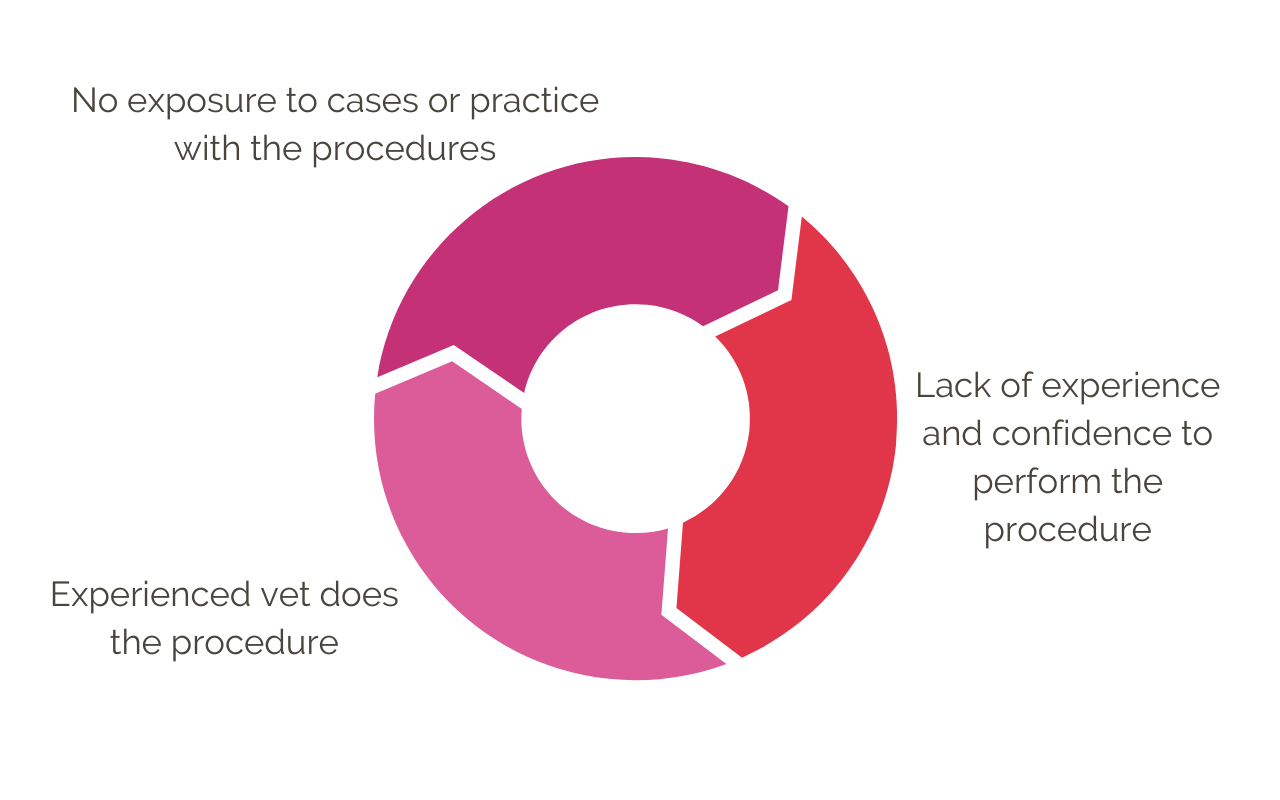
As you probably experience, when we’re starting out with a new skill, we usually do not have this “minimal level of competency” - heck, that’s why we want to become better at it! This is the main reason why it’s hard to start developing a certain skill in practice, unless some very specific conditions take place (we’ll discuss them later). However, in a typical clinical setting where a patient needs the procedure done, an inexperienced colleague will only do it if there is no alternative, with a lot of discussion with the clients if it’s a life or death situation. If there is an experienced colleague, either within the practice or a referral centre, it may be done by them instead. Even when it’s done at the practice you work in and you’d have the chance to assist with it, you are most likely busy doing something else that you are able to do. And thus the cycle repeats, as you yourself don’t have the ability to practise and repeat the skill.
Why do we wish for more?
Breaking the cycle and growing your hands-on skills obviously comes with a series of benefits for you and your patients. The first thing you will notice is that you will feel confident and comfortable at the job - sometimes even looking forward to pulling that tooth out! Knowing how to do something often makes you feel more positive emotions - and this is positive in a world where vets suffer emotionally!
But there are other palpable outcomes of improving your professional competence.
Improved clinical outcomes
Of course, if you are more skilled, you will be able to offer more correct diagnoses, less misdiagnoses and even new treatment options. This improves the patient care you can provide (and in theory should also improve your reputation with clients - but we know they can be hard to please!).
Another benefit that we often forget about is that with more experience, you are more efficient: you take less time but don’t lose accuracy. This effectively means you are improving patient welfare (by reducing how long a procedure takes / the anaesthesia needed / the amount of pain), but also means you can help more patients!
Job satisfaction
This is one of the main reasons why we pursue this upskilling, but the best effect of feeling capable is literally being confident about it. Confidence comes from the experience of competence and is positive for your own emotional wellbeing.
But because you are more aware of your skills, you also know you can deliver value - you can assess, diagnose, treat. No more “oh I just looked”; you won’t feel guilty about charging for that ultrasound because you know you can do it after all the effort you’ve gone through to learn it. The fact that you often develop a systematic and repeatable approach means you can apply it to a bunch of cases, even if you’ve not seen something exactly like it before.
Career progression
We rarely discuss it because it feels like a bit of a taboo within the profession to do something because you want better career prospects, but experiencing growth is one of the fundamental needs we have as human beings, and the same is true for our careers.
Developing your competence effectively turns you into a more skilled professional. You can negotiate better pay, better hours or better working conditions. How many times a practice will update their equipment because they have someone that can fully use it?
On the other hand, if you become skilled enough, others may start to search you for advice with their cases. If there are enough cases and not enough skilled workers, you may be able to start your own peripatetic business, or even gain enough experience to facilitate your own progression into a more specialised route. Maybe you find out that you love working with teeth and want to learn maxillofacial surgery. Or that doing ultrasounds is like playing video games and want to learn how to find the smallest detail.
Either way, improving your skills only opens more doors for you to grow.
How do you actually improve your skills if you're stuck in the "no experience" cycle?
The way to break the cycle is to obtain a minimum level of hands-on skills that allows you to start seeing the cases and building your skills. But you still need a series of ingredients to make it work, so pay attention to the list below:
Knowledge Base
This is the Brain Knowledge that you are required to have before you can learn a practical skill. There are two major components related to the knowledge required:
Broad Knowledge: this is knowledge that relates to the Big Picture, the anatomy and physiology of your patient and the pathology they may be experiencing. This is typically obtained at the university level.
Specific Knowledge: this is knowledge that relates directly to the skill you are developing, such as how it works, how to apply it and what results are expected of it. This is often approached at the university level, but it may be very superficially explored.
Let’s say you want to learn ultrasound skills. Before you can pick up the probe, you need to know what the ultrasound machine does, the anatomy of the dog and the cat, what features do you need to adjust and why in the machine, how to hold the probe, how you can move the probe, why you would choose to ultrasound that patient in particular, and this is just to get started...
Most of the time, we already have a solid background from university, as you’ve seen. The good news is that this is also the easiest type of knowledge to obtain from veterinary manuals or online sources, like videos, courses, etc.
Mentoring
Out of all of the components of this list, this is by far the one that is most overlooked, and I personally think it’s the biggest loss! Access to someone that can guide you is instrumental for consistent growth. A mentor is not someone that you call when you’re not sure. A mentor is someone that has the understanding that they are there to teach you to overcome your hurdles and push yourself.
A big myth with mentors is that they should be experts in their field. In reality, a good mentor has two qualities: they are kind and they can show you what you don’t know. They don’t need to be experts, but they need to be a level better than you at whatever it is they are teaching you. Once they’ve taught everything they know, they will happily and proudly let you fly and find another mentor that can push you further.
Repetition
This is one of the most fundamental ingredients, and very much understood by most of us. Skills that involve dexterity need repetition. We know this - an athlete needs to practise intensively if they want to be great at what they do. If you want to learn a routine for a dance show, you need to repeat it to memorise it. Even if you’re a gamer, you need to be able to do your combos by heart if you want to excel. The body needs repetition to memorise what to do.
We’ve also seen that this is one of the factors that leads to being stuck with our growth - you need to repeat the technique plenty of times to be able to do it, and you need to keep doing it so your body keeps remembering it.
Like we’ve seen, this is hard to start with in a clinical setting, but not only because someone else can take over the cases.
Not every dog needs a dental.
Not every vomiting cat needs an abdominal ultrasound.
There may be no cases at all.
This is also why most vets will need to take specific training and courses to have the opportunity to get the knowledge, the repetition and the guidance needed to learn a skill. As you can imagine, the heavier the hands-on component, the more supervised repetition you will have and the better your opportunity to have that skill “dug in” in the network of your brain-body synapses.
These three ingredients are enough to allow you to learn a hands-on skill to a basic competency level, which will allow you to start breaking out of the No Experience Cycle. You can then move onto the Growth Cycle.
The Growth Cycle is a much nicer experience!
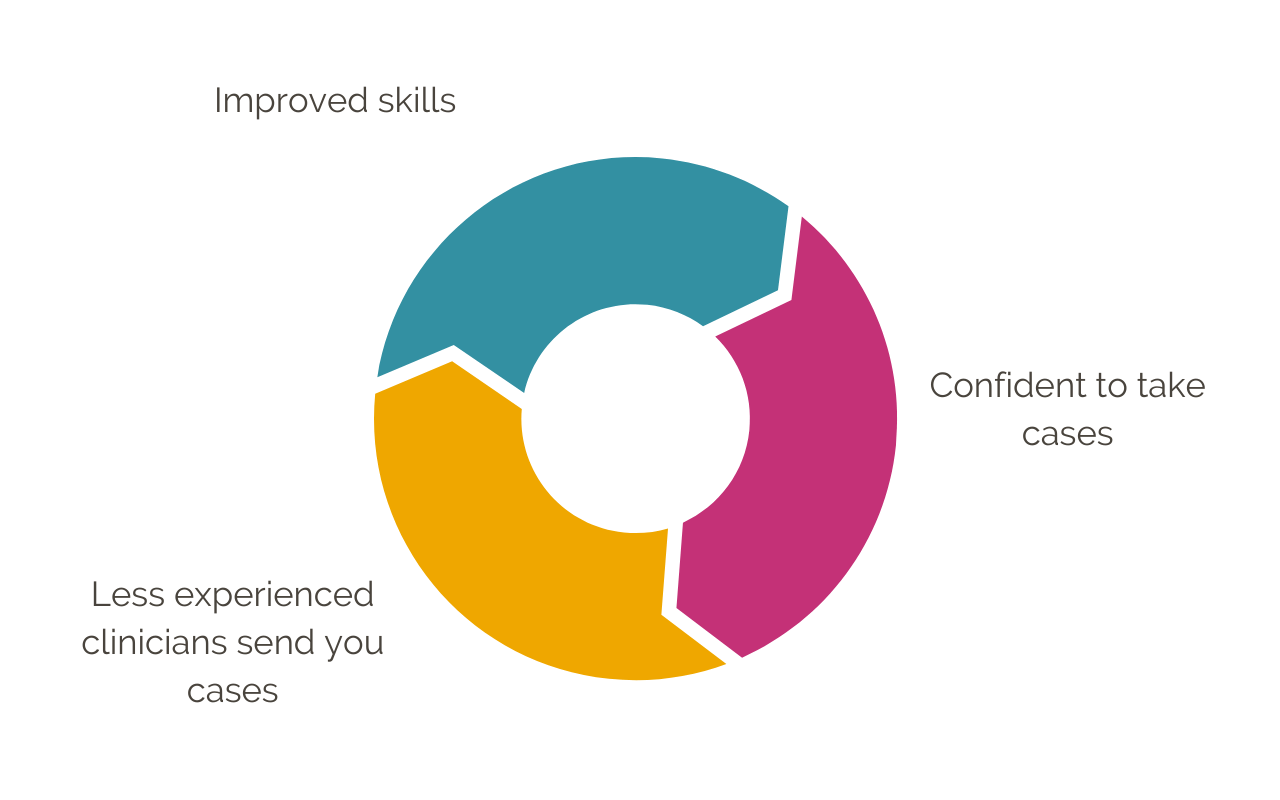
Once you have a certain level of skills, you feel confident taking those cases. You also know you need repetition to keep growing your skills, so the more cases, the better.
But…now you also become more aware of how much you don’t know, and often you want to improve it, because we get good at the things we do often, and we enjoy doing them because we feel good.
So to take it up a notch, you need to improve your proficiency, or in other words, you want to optimise your technique. And for this you need to add two more ingredients.
Consistency
Once you start to develop a skill, your growth is much faster if you focus on a single technique to perform it. You want to make sure you learned a valid technique, and keep using it until you can do it with your eyes closed. It’s not to say that you can’t learn other techniques, but that you should develop a consistent method of performance. This will increase your speed, minimise missteps and omissions and allow you to make little adjustment steps that personally help you. Most vets start to develop tweaks in the methods they learn, which improves how well and fast they can perform.
Persistence
You will have surgical complications. Your gingival flap will fail. You will miss a foreign body. Your anaesthetised patient will die. It happens. Just because things didn’t go the way they were supposed to, it doesn’t mean you’ve done something wrong. So go through it and check if you’ve made mistakes that you can avoid in the future. Check with your more experienced colleagues, learn from the experience and don’t give up. There will always be setbacks. But remember: no one knows everything, and we all make mistakes.
Upskilling outside of practice: finding and selecting training courses
You’ve seen that most clinicians don’t leave university with a high enough level of practical skills to break away from the No Experience Cycle at work. Most of the time, a minimum level of upskilling is necessary to do it, and you often need to get this outside of work. You now know the ingredients required to optimise your learning, but you will find out that many of the courses and training available don’t really help you with all of them.
Unfortunately, you will often find:
A lot of theoretical exposure, often repeating knowledge you already have
A reduced number of hours of hands-on experience, which means your opportunities for repetition are not many
A high number of students per instructor, meaning you don’t get enough supervision or mentoring during your few repetition opportunities
Courses that are “workshops” or “practical”, but where the practice is case-based and not hands-on
Courses that are fairly practical but that take a long time to complete (certificates) and/or cover other topics you don’t want to focus on at the time
The pricing is very high for the level of hands-on opportunity that they provide
Why is it so hard to find good hands-on training opportunities?
You know what it takes for effective learning, so why is it so hard to find training opportunities that match it? As you can imagine, there are a few factors for this!
When someone is learning, they take more time and may make mistakes. Depending on what it is that you are learning, this can negatively impact patient welfare and may even be dangerous without constant direct supervision. No one wants to hurt our patients!
A learning experience where there is one dedicated instructor and one student, which is the optimal one, is not usually financially viable. Why? The instructor will typically be someone with a lot of expertise to contribute to the field, and spending time teaching a student takes away from their opportunity to apply their skills to help patients. In other words, one-to-one would need to be very expensive for the student to compensate the instructor.
Teaching for enough time is a huge investment in resources and facilities. The organiser would need to provide a high enough caseload, properly licensed and equipped facilities and outstanding instructors available for long periods of time in a row. This leads to several problems that need to be overcome: finding enough instructors (and paying them), having enough animals is more difficult and unpredictable than using simulations, VR or cadavers.
Five questions to ask if you want to see if the courses provide good hands-on experience
Below is a list of questions that will help you assess different training opportunities. Whenever possible, get in contact with the organisers to make sure the training opportunities match your development needs.
1) How many students and how many instructors are there?
Ideally, the closer to 1:1 the better - just know that 1:1 is near impossible to find in a real learning setting for the reasons highlighted above.
2) How many hours of practice will I experience?
Depending on the skill, aim for at least 8 to 10 hours of practice. In our experience, complex multi-step skills often require more than 30 hours of hands-on immersion for technical independence.
3) What does the practice look like?
As much as possible, you want an experience close to clinical practice. In some skills, it’s safer to learn with models and simulations (like surgery and dentistry), but eventually you will need to do these with animals. At the same time, for other skills like ultrasound, models and simulators don’t provide you with the right motor memory, so it’s more efficient to learn with a real animal from the beginning.
4) What is the experience of the instructor?
Ideally, the instructor should have real and updated clinical experience and be someone that is also able to teach.
5) How is the welfare of the animals used for teaching?
If there are live animals used for teaching, how is their welfare safeguarded? Especially for skills like surgery, laparoscopy or dentistry, there are welfare implications of prolonged and unsupervised teaching taking place. You want to make sure there are safeguards in place, such as the tutor being able to take over if there is a complication, proper anaesthesia taking place and facilities to tackle unexpected problems.
One of the biggest challenges we experience as students with practical courses is the welfare of animals used for training. It’s only acceptable to do this when there is a clear benefit for that animal and/or when their welfare is not being compromised. For instance, if you’re learning surgery, you will need to already have some skills or be directly guided and supervised during your first procedures. And if you’re doing ultrasound, ideally this will be with a healthy dog that is happy to sleep while you’re doing it, or a sick patient that actually needs the procedure. Would you say it’s better to learn with supervision when there are safeguards in place, or when you have an owned pet and you have to “wing it”?
To new beginnings!
Now that you understand how to improve your practical skills, it’s time to start planning! Do you already know what skills you prefer to do, or you need to learn?
If you are not sure where to start, we have a quick self-assessment tool that allows you to check your competence level in several areas and highlights areas for improvement.
If you do - you also now know how to find appropriate training opportunities and assess other opportunities that arise. Ready to break the cycle? Explore our hands-on academies today and start building your confidence.
Learn something you want, so you can grow to love it and use it to save one more life.
More Articles




Office HQ
Technology House,
9 Newton Place
Glasgow
G3 7PR
Scotland
© UniVets Global 2025. All Rights Reserved.
UniVets Global is the trading name of AD-VETERPRISES LTD. Registered in Scotland, Co. No. SC581517
The UniVets Global Brand and Course Methodology are owned by AD-VETERPRISES LTD (UK).
Physical courses in Portugal are sold and administered by our licensed trading partner, Andreia Dias Veterinária Unipessoal Lda., trading under the name UniVets Global em Portugal.